
Muhammad Iqbal
Islamic philosopher and poet whose work inspired the Pakistan Movement.

Iqbal Academy Pakistan · Public domain
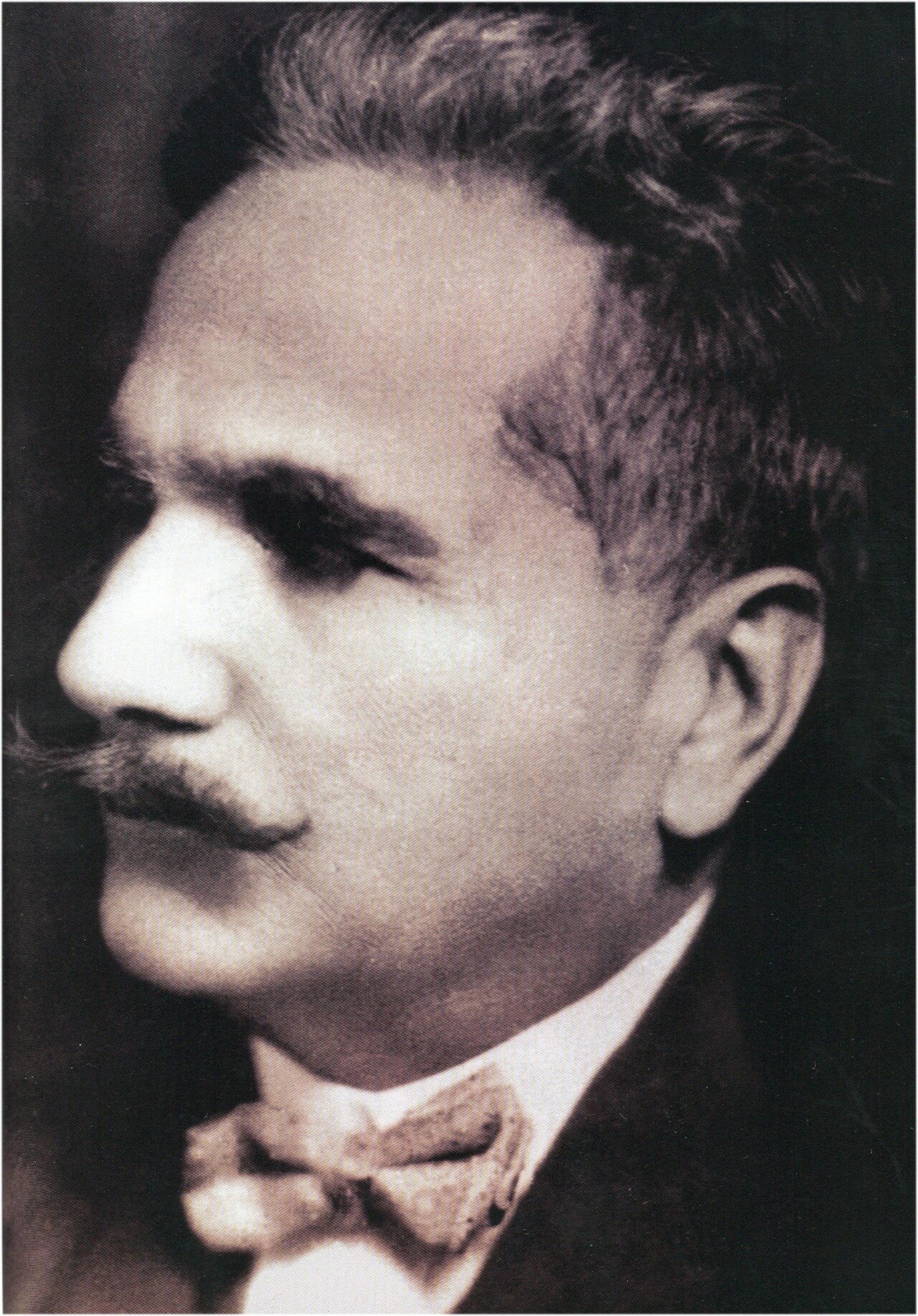
Sir Muhammad Iqbal (9 November 1877 – 21 April 1938) was an Islamic philosopher and poet. His poetry in Urdu is considered among the greatest of the 20th century, and his vision of a cultural and political ideal for the Muslims of British India is widely regarded as having animated the impulse behind the Pakistan Movement. The honorific commonly refers to him as Allamah (Persian: علامه, romanized: 'Allāma, lit. 'learned') and is widely considered one of the most important and influential Muslim thinkers and Islamic religious philosophers of the 20th century.
- born
- 9 November 1877, Sialkot, Punjab, British India
- died
- 21 April 1938
- field
- Islamic philosophy, poetry, law
- nationality
- British Indian
- known_for
- Urdu poetry, Allahabad Address, inspiring the Pakistan Movement
Verified Timeline
Lore & Background
Iqbal was born and raised in Sialkot, Punjab, British India, and studied at Scotch Mission College in Sialkot and Government College University in Lahore. He taught Arabic at the Oriental College, Lahore, from 1899 until 1903, during which time he wrote prolifically. Notable among his Urdu poems from this period are "Parinde Ki Faryad" ("A Bird's Prayer"), an early contemplation on animal rights, and "Tarana-e-Hindi" ("Anthem of the Indians"), a patriotic poem—both composed for children. In 1905, he departed from India to pursue further education in Europe, first in England and later in Germany. In England, he earned a second BA at Trinity College, Cambridge, and subsequently qualified as a barrister at Lincoln's Inn. In Germany, he obtained a PhD in philosophy at the Ludwig-Maximilians-Universität München (LMU), with his thesis focusing on "The Development of Metaphysics in Persia" in 1908. Upon his return to Lahore in 1908, Iqbal established a law practice but primarily focused on producing scholarly works on politics, economics, history, philosophy, and religion. He is most renowned for his poetic compositions, including "Asrar-e-Khudi", "Rumuz-e-Bekhudi", and "Bang-e-Dara". His literary works in the Persian language garnered him recognition in Iran. Iqbal married four times under different circumstances. His first marriage was in 1895 to Karim Bibi, and the couple had two children: a daughter, Miraj Begum (1895–1915), and a son, Aftab Iqbal (1899–1979), who became a barrister. Iqbal and Karim Bibi separated somewhere between 1910 and 1913. His second marriage took place on 26 August 1910 with the niece of Hakim Noor-ud-Din. His third marriage was with Mukhtar Begum in December 1914; they had a son, but both mother and son died shortly after birth in 1924. Later, Iqbal married Sardar Begum, and they became the parents of a son, Javed Iqbal (1924–2015), who became Senior Justice of the Supreme Court of Pakistan, and a daughter, Muneera Bano (born 1930). He was elected to the Punjab Legislative Council in 1927 and held several positions in the All-India Muslim League. In his Allahabad Address, delivered at the League's annual assembly in 1930, he formulated a political framework for the Muslim-majority regions spanning northwestern India, spurring the League's pursuit of the two-nation theory.
Reader's Guide
Iqbal's significance lies in his dual role as a poet and political thinker. An ardent proponent of the political and spiritual revival of the Muslim world, particularly of the Muslims in the Indian subcontinent, the series of lectures Iqbal delivered to this effect were published as *The Reconstruction of Religious Thought in Islam* in 1930. His Urdu poetry is considered among the greatest of the 20th century, and his Persian works earned him recognition in Iran. The Allahabad Address in 1930 provided a political framework for Muslim-majority regions of northwestern India, which animated the Pakistan Movement. In August 1947, nine years after Iqbal's death, the partition of India gave way to the establishment of Pakistan, a newly independent Islamic state in which Iqbal was honoured as the national poet. He is also known in Pakistani society as Hakim ul-Ummat (lit. 'The Wise Man of the Ummah') and as Mufakkir-e-Pakistan (lit. 'The Thinker of Pakistan'). The anniversary of his birth (Youm-e Weladat-e Muḥammad Iqbal), 9 November, is observed as a public holiday in Pakistan.
Did You Know?
- Iqbal's mother-tongue was Punjabi, and he conversed mostly in Punjabi and Urdu in his daily life.
- He mastered German in three months while studying in Heidelberg in 1907.
- His doctoral thesis at LMU Munich was titled 'The Development of Metaphysics in Persia' and was published in London in 1908.
- Iqbal's grandfather was an eighth cousin of Sir Tej Bahadur Sapru, an important lawyer and freedom fighter.
- A street in Heidelberg has been named in his memory, 'Iqbal Ufer'.
Education and Intellectual Formation
Iqbal's intellectual formation began in Sialkot, where at four he was sent to a mosque to study the Qur'an. His teacher, Syed Mir Hassan, head of the local madrasa and an Arabic professor at Scotch Mission College, grounded him in Arabic and Persian. As a teenager he was already publishing verse in literary journals under his pen-name. He matriculated from Scotch Mission College in 1893, standing first in his grade, and earned his intermediate diploma in 1895. That year he enrolled at Government College, Lahore, completing a BA in philosophy, English literature, and Arabic by 1897, winning a university medal for his Arabic work. He followed with an MA in 1899, placing first in philosophy at the University of the Punjab. From 1899 to 1903 he taught Arabic at the Oriental College in Lahore, a period of prolific creative output. In 1905 he departed for Europe, earning a second BA at Trinity College, Cambridge, qualifying as a barrister at Lincoln's Inn, and completing a PhD in philosophy at the University of Munich in 1908, his thesis tracing the development of metaphysics in Persia.
Poetic and Philosophical Legacy
Iqbal's poetic corpus ranks among the most celebrated in twentieth-century Urdu literature, and his philosophical writings secured him a distinguished place in Islamic intellectual history. His most renowned collections—Asrar-e-Khudi, Rumuz-e-Bekhudi, and Bang-e-Dara—explore themes of selfhood, spiritual transcendence, and the awakening of a collective Muslim consciousness. His earlier works from the Lahore period, composed for young readers, include "Parinde Ki Faryad," an early reflection on animal welfare, and "Tarana-e-Hindi," a patriotic verse celebrating the Indian people. Beyond Urdu, Iqbal produced significant literary work in Persian, which earned him recognition and a devoted readership in Iran. His philosophical contributions extended well beyond poetry: his 1930 publication, The Reconstruction of Religious Thought in Islam, distilled a series of lectures into a systematic argument for the spiritual and political renewal of the Muslim world. Widely regarded as one of the most influential Islamic thinkers of his century, Iqbal is honored with the title Allamah, signifying his standing as a learned scholar whose ideas continue to shape religious and philosophical discourse.
Political Vision and the Pakistan Movement
Iqbal's political thought left an indelible mark on the destiny of the Indian subcontinent. As an active member of the All-India Muslim League and a member of the Punjab Legislative Council elected in 1927, he channeled his philosophical convictions into concrete political advocacy. His landmark Allahabad Address, delivered at the League's annual assembly in 1930, articulated a vision for a distinct political and cultural space for the Muslim-majority regions of northwestern India. This formulation gave intellectual momentum to what would become the two-nation theory and the broader Pakistan Movement. Iqbal's wider project of Muslim revival—spanning spiritual, political, and economic dimensions—was set out in his lectures later published as The Reconstruction of Religious Thought in Islam. Though he passed away in April 1938, his vision was realized in August 1947 when the partition of India produced the independent state of Pakistan. There, Iqbal is revered as the national poet, known by the titles Hakim ul-Ummat, "The Wise Man of the Ummah," and Mufakkir-e-Pakistan, "The Thinker of Pakistan." His birth anniversary, 9 November, is observed as a public holiday across the country.
Family Roots and Personal Life
Iqbal's personal story is woven with threads of cultural transition and familial devotion. Born into a Punjabi family of Kashmiri Pandit descent—ancestors from the Sapru clan of Kulgam who embraced Islam in the fifteenth century—his grandfather's family had migrated to Punjab during the Sikh conquest of Kashmir. His father, Sheikh Noor Muhammad, was a tailor with no formal education but a deep piety, while his mother, Imam Bibi, was remembered for her humility and generosity toward the poor. Iqbal spoke Punjabi and Urdu in daily life and frequently celebrated his Kashmiri heritage in his verse, identifying himself as a son of Kashmiri Brahmins steeped in the wisdom of Rumi. His mother's death in November 1914 struck him deeply, and he composed an elegy expressing his grief. Iqbal married four times over his lifetime. His first wife, Karim Bibi, bore him a daughter, Miraj Begum, and a son, Aftab Iqbal, who became a barrister. Despite their separation between 1910 and 1913, Iqbal continued to provide for her financially until his own death in 1938. His later marriages included Sardar Begum, with whom he had a son, Javed Iqbal, who would rise to become a Senior Justice of the Supreme Court of Pakistan.
Gallery
Frequently Asked Questions
Who is Muhammad Iqbal?
Muhammad Iqbal was a British Indian Islamic philosopher, poet, and lawyer born in Sialkot, Punjab, in 1877. He is widely regarded as one of the most influential Muslim thinkers of the 20th century.
What is Muhammad Iqbal known for?
He is best known for his Urdu poetry, often ranked among the finest of the 20th century, and for articulating a distinct cultural and political vision for Muslims in British India.
How did Muhammad Iqbal connect to the Pakistan Movement?
His philosophical ideas about a separate homeland and cultural identity for Muslims in the subcontinent are widely seen as having energized the political drive that eventually led to Pakistan's creation.
What was Muhammad Iqbal's Allahabad Address?
Delivered in 1930, this speech laid out his vision for a self-governing Muslim state in northwestern India and is often cited as a key philosophical precursor to the Pakistan Movement.
When and where did Muhammad Iqbal die?
He passed away on 21 April 1938, in his early sixties, leaving behind a body of poetry and philosophical work that continues to shape Islamic thought.
More in Philosophers & Thinkers 25-40
Elsewhere in the Philosophers & Thinkers universe
Spotted an error? Know more?
This is a living reference — every entry is fact-audited, and reader corrections feed straight into our audit queue. Suggest an edit · See this site's audit record