
Jacques Derrida
French philosopher who developed deconstruction, influencing humanities and social sciences.

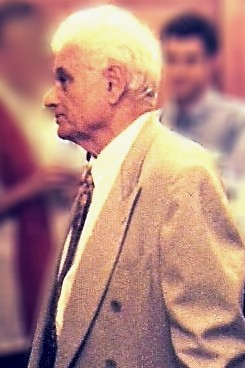
Frege-Pierre Dubois · CC BY-SA 4.0
Jacques Derrida was a French philosopher who developed deconstruction, a method of critical analysis he applied through close readings of Saussure's linguistics and Husserlian and Heideggerian phenomenology. He is a major figure associated with post-structuralism and postmodern philosophy, though he distanced himself from post-structuralism and disavowed the word "postmodernity." Over his career, he published over 40 books and hundreds of essays and public presentations, influencing the humanities and social sciences including philosophy, literature, law, anthropology, historiography, applied linguistics, sociolinguistics, psychoanalysis, music, architecture, and political theory. Into the 2000s, his work retained major academic influence in the United States, continental Europe, South America, and other regions where continental philosophy is predominant, particularly in debates on ontology, epistemology, ethics, aesthetics, hermeneutics, and the philosophy of language.
- born
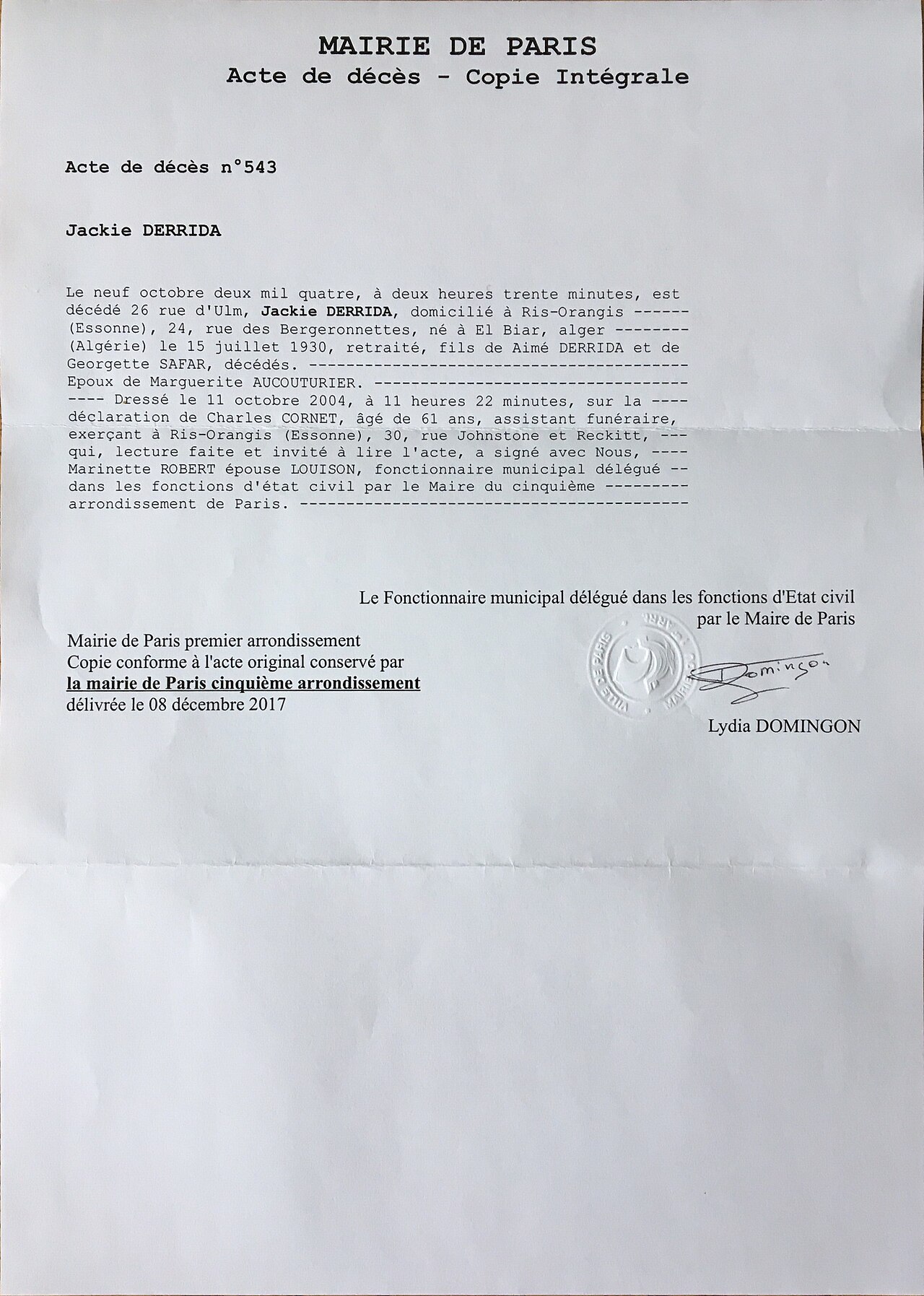
- 15 July 1930
- died
- 9 October 2004
- field
- Philosophy
- nationality
- French
- known_for
- Deconstruction
Verified Timeline
Lore & Background
Derrida was born Jackie Élie Derrida on 15 July 1930 in a summer home in El Biar, Algeria, to a Sephardic Jewish family. His father, Haïm Aaron Prosper Charles Derrida, worked all his life for the wine and spirits company Tachet, including as a travelling salesman—a job his son called "exhausting" and "humiliating." On the first day of the 1942 school year, French administrators in Algeria, implementing antisemitism quotas set by the Vichy government, expelled Derrida from his lycée. He secretly skipped school for a year rather than attend the Jewish lycée formed by displaced teachers and students, and took part in numerous football competitions, dreaming of becoming a professional player. In his teenage years he found in works by Rousseau, Nietzsche, and Gide an instrument of revolt, and his reading also included Camus and Sartre. In 1949 he moved to Paris, attending the Lycée Louis-le-Grand, where his philosophy professor was Étienne Borne. He failed his entrance exam to the École Normale Supérieure on his first try, passed on the second, and was admitted in 1952. On his first day at ENS he met Louis Althusser, with whom he became friends. After visiting the Husserl Archive in Leuven, Belgium (1953–1954), he completed his master's degree on Edmund Husserl. He passed the agrégation exam in 1956, received a grant for studies at Harvard University, and spent the 1956–57 academic year reading James Joyce's Ulysses at the Widener Library.
Reader's Guide
Derrida's significance lies in his development of deconstruction, which he applied in some of his texts and developed through close readings of Saussure's linguistics and Husserlian and Heideggerian phenomenology. His first three books—Writing and Difference, Speech and Phenomena, and Of Grammatology—were all published in 1967. His work gained international prominence with his contribution "Structure, Sign, and Play in the Discourse of the Human Sciences" to a 1966 colloquium on structuralism at Johns Hopkins University, where he also met Jacques Lacan and Paul de Man. During the Algerian War (1954–1962), Derrida asked to teach soldiers' children in lieu of military service, teaching French and English from 1957 to 1959. From 1960 to 1964 he taught philosophy at the Sorbonne as an assistant to Suzanne Bachelard, Georges Canguilhem, Paul Ricœur, and Jean Wahl. In 1964, on the recommendation of Louis Althusser and Jean Hyppolite, he received a permanent teaching position at the ENS, which he kept until 1984. He co-founded the Collège international de philosophie in 1983 and was elected its first president. In 1986 he became Professor of the Humanities at the University of California, Irvine, where he taught until shortly before his death in 2004. His work influenced architecture (deconstructivism), music (hauntology), art, and art criticism. Particularly in his later writings, Derrida addressed ethical and political themes. Some critics consider Speech and Phenomena (1967) his most important work, while others cite Of Grammatology (1967), Writing and Difference (1967), and Margins of Philosophy (1972).
Did You Know?
- Derrida was originally named Jackie, which his parents considered an American name, after the child actor Jackie Coogan who starred in the 1921 Charlie Chaplin film The Kid.
- He was expelled from his lycée on the first day of the 1942 school year due to antisemitic quotas set by the Vichy government in Algeria.
- Derrida dreamed of becoming a professional football player and took part in numerous football competitions during his adolescence.
- He spent the 1956–57 academic year at Harvard University reading James Joyce's Ulysses at the Widener Library.
- Derrida co-founded the Collège international de philosophie in 1983 and was elected its first president.
Political Philosophy and Enduring Influence
Rousseau's political writings remain foundational texts in Western thought. His Discourse on Inequality made the radical argument that private property, rather than natural human differences, was the root cause of social inequality. The Social Contract went further, attempting to articulate the conditions under which a political order could be considered legitimate. Together, these two works became cornerstones of modern political and social philosophy. His ideas rippled outward across Europe during the Age of Enlightenment, shaping intellectual discourse far beyond Geneva. Elements of his thinking also fed into the currents that would eventually produce the French Revolution. Beyond pure politics, his influence extended into economic and educational thought, where questions about the individual's place within collective structures continue to resonate. He was, in the broadest sense, a Genevan philosopher and philosophe whose work helped redefine how Europeans understood the relationship between the individual, society, and the state.
Literary Innovation and the Modern Self
Beyond his political theorizing, Rousseau reshaped the landscape of European literature. The following year, Émile, or On Education, offered a treatise exploring how the individual should be situated within society, blending pedagogical philosophy with narrative. His autobiographical works pushed further into new territory. The Confessions, completed in 1770 and published after his death, is credited with initiating the modern autobiography as a literary form. Both works exemplify the late eighteenth-century Age of Sensibility, marking a decisive shift toward subjectivity and introspection that would later become defining features of modern writing.
Geneva's Democratic Facade
In theory, the city was governed democratically by its male voting citizens. The gap between democratic ideals and oligarchic reality generated fierce political debate that reached even the tradespeople. Rousseau's own grandfather had supported Fatio and was penalized for it. Despite this, Rousseau took pride in his family's middle-class status and voting rights, consistently signing his works Jean-Jacques Rousseau, Citizen of Geneva.
A Childhood Shaped by Loss and Class
Rousseau's early life was marked by loss and social displacement. He was born on 28 June 1712, and later recalled being born almost dying. His mother, Suzanne, died of puerperal fever just nine days after his birth, an event he described as the first of his misfortunes. He and his brother François were raised by their father Isaac, a well-educated watchmaker and music lover, and a paternal aunt. When Rousseau was five, his father sold the family home and moved them from an upper-class neighborhood into a district of silversmiths, engravers, and other craftsmen. Growing up among artisans, young Rousseau absorbed class tensions as the working people agitated against the privileged ruling families. His father had himself faced political trouble in 1699 after a quarrel with visiting English officers ended with Isaac being punished rather than the foreign visitors. Even in small domestic moments, such as his father reading adventure stories aloud each evening to cultivate a love of letters, the seeds of a life devoted to questioning power and championing the individual were being planted.
Gallery
More in Philosophers & Thinkers 1-24
Elsewhere in the Philosophers & Thinkers universe
Spotted an error? Know more?
This is a living reference — every entry is fact-audited, and reader corrections feed straight into our audit queue. Suggest an edit · See this site's audit record