
Nāgārjuna
Indian philosopher and founder of the Madhyamaka school of Buddhism.

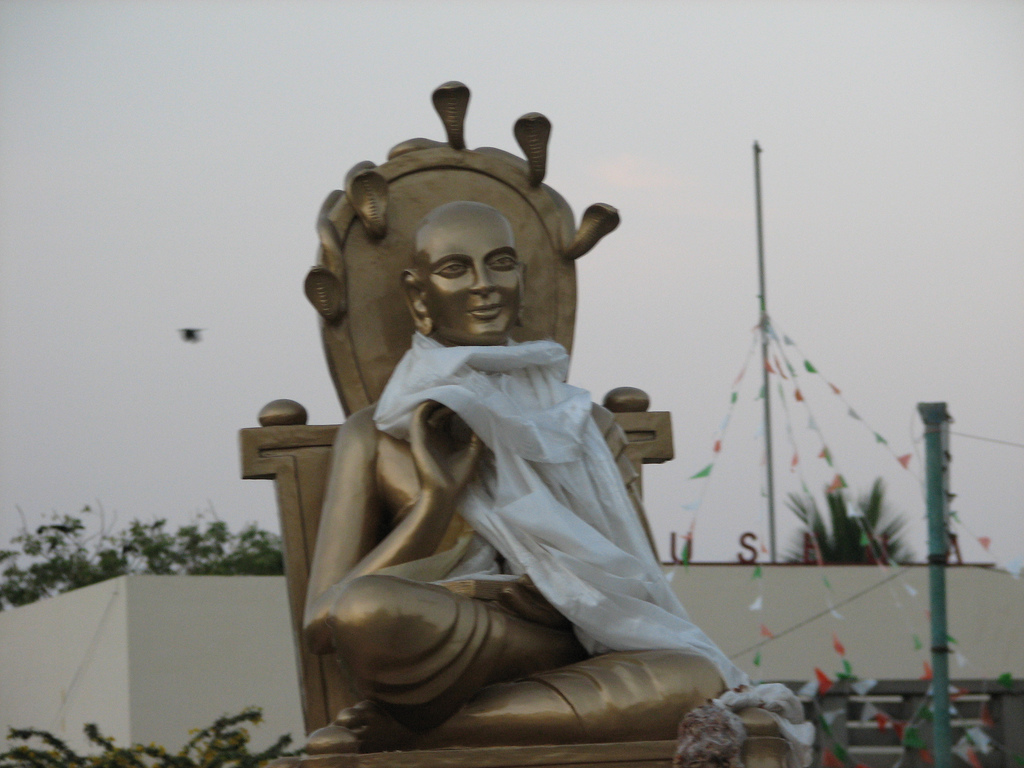
Nikhilb239 · CC BY-SA 4.0
Nāgārjuna (Sanskrit, from Nāga + Arjuna; c. 150 – c. He is considered the founder of the Madhyamaka (Centrism, Middle Way) school and is widely regarded as the most important Buddhist philosopher after the Buddha himself. In Tibetan Buddhism, he is called the 'second Buddha.' His treatises are the foundational texts of the view of emptiness (Śūnyatāvāda) or Madhyamaka, and his philosophical writings on emptiness influenced Indian philosophy for a millennium, remaining an indispensable doctrinal source for Mahāyāna Buddhism in East Asia and Indo-Tibetan Buddhism.
- born
- c. 150 CE (conventional date, disputed)
- field
- Buddhist philosophy, Madhyamaka
- nationality
- Indian (south India)
- known_for
- Founder of Madhyamaka school; author of Mūlamadhyamakakārikā; doctrine of emptiness (śūnyatā)
Lore & Background
Very little is reliably known of Nāgārjuna's life, and modern historians do not agree on a specific date or place. Most scholars place him in South India between the 1st and 3rd centuries CE. Surviving accounts were written in Chinese and Tibetan centuries after his death and are mostly hagiographical and historically unverifiable. Some scholars, such as Joseph Walser, argue that Nāgārjuna was an advisor to a king of the Sātavāhana dynasty, possibly Yajña Śrī Śātakarṇi (c. second half of the 2nd century), based on archaeological evidence at Amarāvatī. Walser also suggests that when Nāgārjuna wrote the Ratnavali, he likely lived in a mixed monastery where Mahāyānists were the minority, possibly affiliated with the Purvasailya, Aparasailya, or Caityaka schools (Mahāsāṃghika sub-schools), in the Andhra region around Dhanyakataka (modern-day Amaravati). Traditional accounts depict Nāgārjuna as the greatest bodhisattva since Śākyamuni, living during a time when the Dharma was 'decadent and weak' and saving the Mahāyāna through debate and textual composition. According to Huiyuan's preface to the Da zhidu lun, Nāgārjuna became a monk, dwelt in seclusion, practiced dhyāna, and after an awakening traveled to the Himālayas to receive Mahāyāna teachings from a śramaṇa. He then went to the palace of the nāgas, where he mastered all canons and secret texts. Later hagiographies, both Chinese and Tibetan, describe him as a Brahmin who mastered the Vedas, converted to Buddhism, and traveled to the palace of dragons under the ocean. They also depict him as a spellcasting wonderworker, master of mantras and alchemy, who defeated Brahmins in debates and magic duels. Traditional sources associate him with revealing the Prajñāpāramitā sūtras after they had been hidden, and with the Vajrayana tradition, ayurvedic alchemy (rasāyana), and the Pure Land tradition, which considers him its first patriarch.
Reader's Guide
Nāgārjuna's significance lies in his foundational role in Mahāyāna Buddhist philosophy. He is considered the founder of the Madhyamaka school, which centers on the doctrine of emptiness (śūnyatā). His most important text, the Mūlamadhyamakakārikā (Root Verses on Madhyamaka, MMK), is the key work on Madhyamaka philosophy and inspired numerous commentaries in Sanskrit, Chinese, Tibetan, Korean, and Japanese, continuing to be studied today. His philosophical writings on emptiness influenced Indian philosophy for a millennium and remain an indispensable doctrinal source for Mahāyāna Buddhism in East Asian and Indo-Tibetan traditions. Nāgārjuna is widely considered the most important Buddhist philosopher after the Buddha, and in Tibetan Buddhism he is called the 'second Buddha.' He was a well-known defender of the Mahāyāna movement, which at the time was a minority within the Buddhist community. His treatises (śāstras) are the foundational texts of the Śūnyatāvāda or Madhyamaka school. Nāgārjuna remains a key figure in all contemporary traditions of Mahāyāna Buddhism. Traditional accounts also link him to the transmission of esoteric teachings, the Pure Land tradition, and alchemical practices, though these are based on later hagiographies rather than verifiable history.
Did You Know?
- Nāgārjuna is called the 'second Buddha' in Tibetan Buddhism.
- His most important text, the Mūlamadhyamakakārikā, continues to be studied today and inspired commentaries in multiple languages.
- Traditional accounts claim Nāgārjuna retrieved the Prajñāpāramitā sūtras from the palace of the nāgas, either in the Himalayas or at the bottom of the ocean.
- The Pure Land tradition considers Nāgārjuna its first patriarch, based on a Chinese translation of the Dasabhumikavibhāsā.
Architect of the Middle Way
Nāgārjuna stands as the founding intellectual figure of the Madhyamaka school, a philosophical tradition centered on the doctrine of emptiness (śūnyatā). His Sanskrit treatises became the doctrinal bedrock for an entire lineage of Buddhist thought that would shape religious and philosophical life across Asia. The Mūlamadhyamakakārikā, commonly abbreviated MMK, remains the single most significant text articulating this philosophy of emptiness. Its influence radiated far beyond the Indian subcontinent: commentaries were composed in Sanskrit, Chinese, Tibetan, Korean, and Japanese, and the work continues to be studied in both academic and monastic settings to this day. In Tibetan Buddhist circles, Nāgārjuna occupies a status almost unparalleled—he is referred to as the "second Buddha," a designation reserved for no other figure after the historical Śākyamuni. His writings shaped Indian philosophical discourse for roughly a millennium and remain an indispensable doctrinal source for Mahāyāna Buddhism in both East Asian and Indo-Tibetan traditions.
A Minority Voice in a Divided Buddhist World
When Nāgārjuna was active, India was politically fragmented, with the Kushan Empire and the Satavahana Kingdom among the principal powers. The Buddhist community itself was already splintered into numerous competing schools spread across the subcontinent. Within this landscape, the Mahāyāna movement existed as a small, largely unrecognized current. As scholar Joseph Walser has observed, before the fifth century, Mahāyāna was "largely invisible," functioning as a minority position within the broader nikāya Buddhist fold. Early Mahāyāna sūtras, including the Aṣṭasāhasrikā Prajñāpāramitā, were circulating in limited circles by the second century, but the movement had not yet achieved the prominence it would later enjoy. Nāgārjuna's role as a defender of Mahāyāna teachings placed him squarely within this nascent, contested environment, championing ideas that most of the established Buddhist community had yet to embrace.
The Elusive Subject of Historical Inquiry
Reliable biographical information about Nāgārjuna is remarkably scarce, and modern scholars disagree on both his exact dates and his place of origin, with multiple locations across India proposed. The surviving accounts were composed in Chinese and Tibetan centuries after his death and are overwhelmingly hagiographical in character, making them historically difficult to verify. The earliest sources trace back to the circle of the Kuchan translator Kumārajīva (344–413 CE) and are sparse in detail, while Tibetan narratives date from the eleventh century onward. Scholar Joseph Walser has argued that Nāgārjuna likely served as an advisor to a Sātavāhana king ruling the Deccan Plateau, and that he composed the Ratnavali within a mixed monastery—home to both Mahāyāna and non-Mahāyāna monks, with Mahāyānists in the minority—probably in the Andhra region near modern Amaravati, sometime in the latter decades of the second century.
The Legend of the Mahāyāna Revivalist
Traditional biographical narratives, whether Chinese or Tibetan, consistently cast Nāgārjuna as the figure who rescued a faltering Mahāyāna tradition. In a preface to the Da zhidu lun attributed to Huiyuan, he is described as a virtuous man who, grieved by the delusion of ordinary people, took monastic vows, withdrew to forests and swamps, and practiced deep meditative absorption. After an awakening, he is said to have traveled to the Himalayas to receive Mahāyāna teachings from a śramaṇa, and then descended to the palace of the nāgas, where he mastered every important canon and secret text. Later Chinese hagiographies add that he was originally a Brahmin who had mastered the Vedas before converting, and they fill his story with miraculous episodes of spellcasting and wonder-working. In Tibetan Buddhism, his designation as the "second Buddha" cements his identity as the great Mahāyāna revivalist who, through debate and composition, reinvigorated the Greater Vehicle in an age of decline.
Gallery
Frequently Asked Questions
What is Nāgārjuna's central philosophical doctrine?
His core teaching is the doctrine of emptiness (śūnyatā), which holds that all phenomena lack inherent, independent existence. Rather than asserting nihilism, he argued that things exist only in dependence on causes, conditions, and conceptual designations.
What is the Madhyamaka school and how did Nāgārjuna establish it?
Madhyamaka, often translated as 'the Middle Way' or 'Centrism,' is a Buddhist philosophical tradition Nāgārjuna founded to resolve the extremes of eternalism and annihilationism. He systematized this view through dialectical analysis, showing that any fixed, self-existent nature in phenomena is logically untenable.
Why do Tibetan Buddhists call Nāgārjuna the 'second Buddha'?
In Tibetan Buddhist tradition, he is honored with this title because his systematic exposition of emptiness is seen as clarifying and preserving the Buddha's own teaching more thoroughly than any other figure. His treatises became the foundational philosophical texts for Mahayana practice and study across the tradition.
What is Nāgārjuna's most important work?
His seminal text is the Mūlamadhyamakakārikā (Root Verses on the Middle Way), a collection of verses that systematically examines and deconstructs common assumptions about existence, causation, and self. It remains the primary reference point for Madhyamaka reasoning across East and Southeast Asian Buddhist traditions.
More in Philosophers & Thinkers 25-40
Elsewhere in the Philosophers & Thinkers universe
Spotted an error? Know more?
This is a living reference — every entry is fact-audited, and reader corrections feed straight into our audit queue. Suggest an edit · See this site's audit record